KISMET

KISMET– Sustainable Food Environments -project themes include the bioeconomy, circular economy, sustainable local food production, and innovation activities. The project aims to develop sustainable local food production with a stronger focus on circular economy solutions.
The project involves 13 partners from the Baltic Sea Region, forming eight Local Innovation Partnerships. One of these local innovation partnerships was established in Satakunta, where different stakeholders collaboratively piloted new sustainable food production solutions.
The project implementation period was from 1 January 2023 to 31 December 2025, with a total budget of € 3.6 million. The budget of Prizztech Oy is € 291,488. The project was funded by the European Union’s Baltic Sea Region Programme (80%) and co-financed by the project partners (20%).
Project partners:
- City of Hamburg (Lead Partner)
- Steinbeis Transfer GmbH
- Municipality of Södertälje
- Foodworks Association
- Vidzeme Planning Region
- Municipality of Vejle
- Stiftelsen Beras International
- Tartu BT Park OÜ
- ScanBalt MTÜ
- Lithuanian Innovation Centre
- Food Organisation of Denmark
- Prizztech Oy
- South-Eastern Finland University of Applied Sciences
The Regional Council of Satakunta participates in the KISMET project as an associated partner.
Project Work Packages
WP1 Preparation of Measures
Work Package 1 includes, among other things, identifying drivers related to demand, production, and supply. In addition, the eight Local Innovation Partnerships will be launched. This work package will also create a plan for evaluating the project activities and defining evaluation criteria.
WP2 Piloting and Evaluation of New Solutions
In Work Package 2, concepts developed within the KISMET project will be piloted locally in each participating region. The experiences gathered will be compiled into an Enabling Program for sustainable food systems, which will help share pilot experiences, highlight best practices, and support food cluster stakeholders in finding information and developing effective solutions.
WP3 Implementation and Dissemination of Results
In Work Package 3, the project results will be disseminated to the target groups, namely municipalities and cities across the Baltic Sea Region, through communication activities. Information will also be targeted at key stakeholders. The methods and results developed in the project will be shared with so-called replicator and friend cities.
Explore the project materials, publications, and videos: KISMET Materials and Videos
Additional information:
Sami Leppimäki
sami.leppimaki@prizz.fi
Concepts
The concepts developed within the KISMET project are based on key themes identified as essential for sustainable local food systems. These themes include building regional food strategies and networks, collecting and making better use of food cluster data, improving communication, reducing food waste, promoting seasonal thinking, and supporting local production.
Comprehensive descriptions of the concepts and their local applications can be found on the project website.
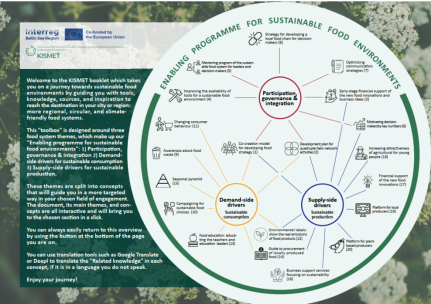
Examples of KISMET Concepts
Concept 1: CO-CREATION OF A FOOD STRATEGY
Concept Description
A successful regional food strategy requires broad participation and commitment from various stakeholders. Close cooperation between different actors within the food system is essential for success. Unlike traditional top-down approaches, which may overlook key stakeholders in the food industry, the co-creation process actively involves them in shaping the strategy. This approach ensures that the final plan meets the needs and expectations of the stakeholders directly affected by it.
The main objective of the concept is to develop a user-centered co-creation model that engages stakeholders such as developers, producers, and businesses. The goal is to create shared understanding and a sense of ownership of the food strategy. The strategy process should include concrete examples of practical implementations and existing actions that support the realization of the vision.
Local Applications
Hamburg: In Hamburg, key actors involved in implementing the food strategy, as well as the required funding and political support, are being identified. Activities include building political and scientific networks and coordinating stakeholder meetings.
South Savo: South-Eastern Finland University of Applied Sciences is developing an action plan for creating a more sustainable food environment by utilizing co-creation methods such as workshops and stakeholder engagement to ensure that the plan responds to local needs.
Vejle: The “Mad som motor” action plan focuses on increasing the use of plant-based meals and strengthening local plant-based food production. Stakeholders include municipal nutrition experts and local producers.
Vidzeme: The Vidzeme region is developing a strategic roadmap to guide the development of the food system. The roadmap includes stakeholder engagement and a clear action plan.
Concept 14: GUIDE TO PROCUREMENT OF LOCALLY PRODUCED FOOD
Procuring locally produced food is a way to strengthen the resilience and crisis preparedness of the public sector. By purchasing food from local producers, municipalities can reduce the risk of supply disruptions and strengthen local food production. Local food production also improves security of supply. Local procurement supports connections between food producers and consumers while benefiting the local economy and the environment. For producers, municipal purchases can provide stability through large purchase volumes, even if the prices may not always be as high as those offered by other customers.
However, procuring locally produced food also involves challenges, such as matching supply and demand, drafting contracts, organizing storage and transportation, and improving cooperation between producers and procurement organizations. This concept provides tested tools and methods for solving these challenges and creating opportunities for local producers and municipal food services.
Local Applications:
Södertälje: The Municipality of Södertälje has developed several strategies to promote local food procurement, including a cultivation strategy, a pollination plan, and a food policy. The municipality has mapped local food production, supported small and medium-sized food companies, and set goals for replacing imported products with local alternatives. In addition, they have established a procurement group focused on finding solutions for local procurement.
Concept 15: SEASONAL FOOD PYRAMID
The Seasonal Food Pyramid is a model based on the environmental and health impacts of seasonally available and locally produced food. The pyramid is divided into three levels:
Top Level: Includes products that should be consumed rarely due to their high environmental impact or lower health value. These include foods imported from outside Europe, such as rice, sugar, and fruits.
Middle Level: Includes foods that can be consumed 2–3 times per week, such as animal-based products that are usually sourced locally or regionally. These products are important as part of a balanced diet but do not need to be consumed daily.
Bottom Level: Includes foods intended for daily consumption, mainly regional or locally produced products. Examples include legumes, root vegetables, and grains, which are both healthy and environmentally friendly options.
Local Applications:
South Savo: South-Eastern Finland University of Applied Sciences is piloting a local version of the Seasonal Food Pyramid in the Savonlinna region in cooperation with Savonlinna public food services. The project covers 25 units serving different age groups and includes a variety of activities promoting seasonal foods. For example, a memory game has been designed for kindergarten children to increase awareness of seasonal foods, a nature-themed adventure game about local foods for primary school students, and an escape room-style game about seasonal products for secondary school students. In addition, the project produces seasonal images of local foods, such as root vegetables and fish, to support memory stimulation among elderly people. XAMK is also preparing marketing materials, such as seasonal posters and participatory events, to engage different customer groups in seasonal thinking and sustainable eating habits.
Vilkaviškis: Lithuanian Innovation Centre aims to increase the use of seasonal food in local cafeterias through various activities. These include raising awareness among cafeteria operators, consumers, producers, and municipal officials about the benefits of seasonal food, as well as strengthening cooperation with local farmers, food communities, and suppliers. LIC aims to develop an information system that facilitates direct procurement and provides training on seasonal food for different stakeholders. In cooperation with local authorities, communities, and stakeholders, LIC seeks to create a supportive ecosystem that enables the use of seasonal food in local cafeterias.
Pilots
KISMET Pilots Implemented in Satakunta
Concept 9: RAISING AWARENESS OF FOOD WASTE
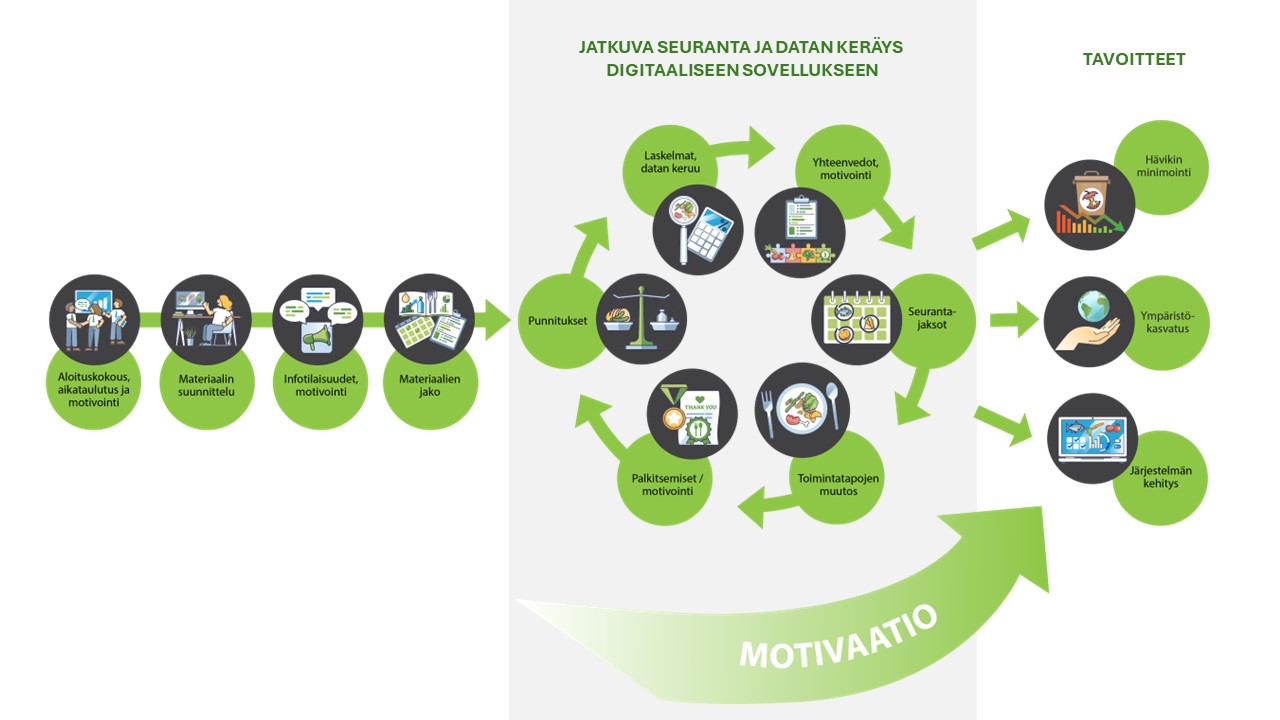
Increasing awareness of food waste has been identified in the KISMET project as one of the key development areas. This concept focuses on reducing and preventing food waste while raising awareness about food loss and waste. The aim is to motivate consumers to make sustainable choices and reduce waste.
Public dining facilities, such as school cafeterias, provide an excellent environment for addressing food waste, as they can influence large numbers of people and promote a culture of sustainable consumption. Schools play a key role in educating students about the environmental, social, and economic impacts of food waste. Support from school management and consistent practices are essential for achieving these goals.
Food service staff play a central role in reducing food waste in school cafeterias. They can implement practical measures, educate students, and develop operating models that minimize waste. In addition, they can engage the entire school community and create innovative solutions that support sustainable development.
Local Applications:
Tartu: In the Tartu region, a school meal development programme called “Making the School Community Food-wise” is being piloted. The aim is to reduce food waste, promote healthy eating habits, and integrate food education into everyday school life. The pilot is being implemented in five schools from October 2024 to April 2025, during which the amount of food waste in schools is measured and analyzed. The schools prepare action plans, and their implementation is supported by experienced mentors.
Satakunta: In the Municipality of Eura, significant reductions in food waste have been achieved at Kiukainen Primary School. A pilot project carried out in 2022 resulted in a 73% reduction in plate waste, reducing both carbon dioxide emissions and costs. Following the success of the pilot, plans have been made to expand the operating model to other schools and food services in Satakunta and across the Baltic Sea Region. Cooperation between kitchen staff and schools has improved food management and communication, reducing unnecessary food orders and improving menu planning.
Within the KISMET project pilot, the experiences gained in Eura regarding food waste reduction have been utilized and the operating model has been further developed for use by other municipalities. Descriptions of the methods have been produced to facilitate their implementation. The objective has been to expand food waste reduction measures to other municipalities and cities. As part of the KISMET project, methods developed in other countries have also been mapped and their suitability for use in Finland has been analyzed.
Proposed Actions:
- Develop and pilot a school meal development programme that includes measures to improve children’s health and well-being while reducing food waste.
- Analyze the food service practices, children’s eating habits, and the amount of food waste in the pilot schools.
- Implement educational activities in cooperation with food services.
- Evaluate the programme’s impact on reducing food waste and expand the operating model to other regions.
Concept 7: OPTIMIZING THE COMMUNICATION STRATEGY
The KISMET project aims to strengthen the international visibility of Satakunta’s bioeconomy and food cluster. The project’s communication concept focuses on developing and compiling communication materials such as videos, PowerPoint presentations, website articles, and social media content that highlight Satakunta as a food region and showcase its strengths, including its unique food culture, innovative businesses, and RDI activities.
The communication activities make use of existing information and materials, which are combined into a comprehensive package suitable for shared use. The development of communication is based on cooperation with local stakeholders, and the content has been planned within the Bioeconomy and Food Cluster RDI Forum of the Regional Council of Satakunta. The aim is to build a strong and internationally recognizable profile for the region as a food province.
The objective is to create unified communication materials that help local stakeholders present Satakunta’s food cluster to international audiences. The target groups include cities, municipalities, and development and expert organizations across the Baltic Sea Region. As part of the concept, a video will be produced in which representatives of authorities and funding organizations discuss Satakunta’s food cluster and its development. The video will be available with subtitles in both Finnish and English.
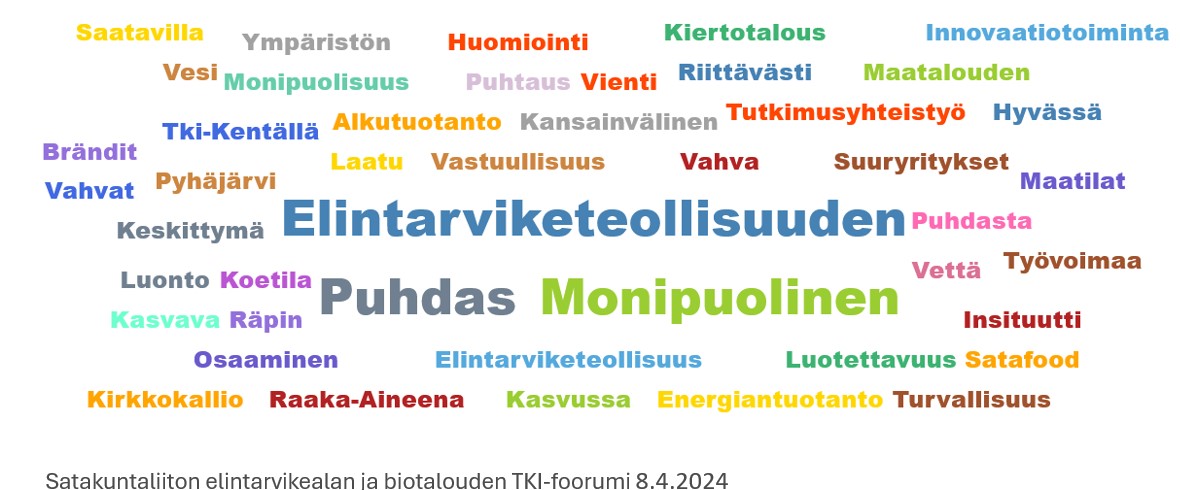
Strengths of Satakunta’s Food Cluster